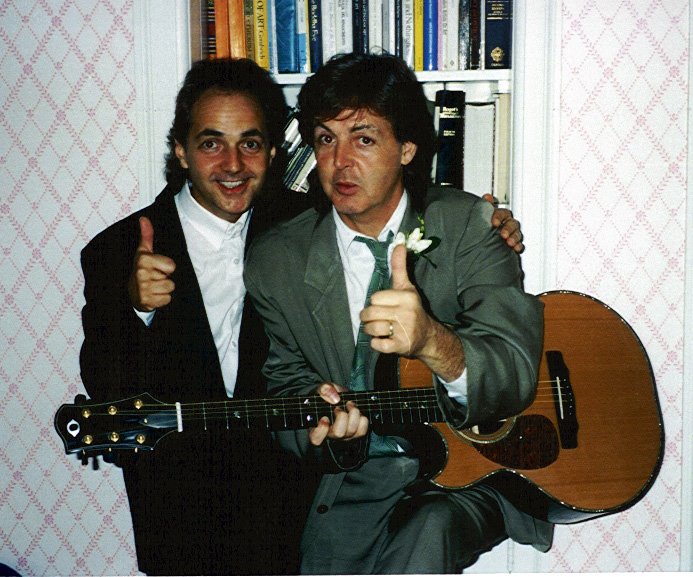
Nice CT interview with Phil Keaggy today. I've been a huge Keaggy fan since I was a teenager, and he has influenced my guitar playing ever since. Aside from being a phenomenally versatile guitarist, Phil has always been a genuine nice guy, which makes a couple of comments in CT a little surprising. In context, he is not bashing anything or anyone, just being honest about some minor annoyances. Says Phil:
What irks me most about the Christian music business is the model on which they built the whole thing. It's based on the world's model of taking songs and masters from artists and owning it, when they make you pay back the production budget based on your royalties' percentage and then they end up owning it. It's like making 30 years of payments on a house that the bank never gives you!
Marvin Olasky has good interview with Westminster Seminary New Testament professor Peter Jones on Gnosticism. Two key exchanges.
"WORLD: Even though The Da Vinci Code invents a marriage between Jesus and Mary Magdalene, it seems that Gnostics have something against heterosexual activity . . .
JONES: The goal of Gnostic sexuality is androgyny, the blending of male and female in one human being. The distinction of male and female is the result of the Fall, and so to undo the effects of the Fall one must join the opposites and make the two one. The "Jesus" of the Gnostic Gospel of Thomas declares, "when you make the male and the female one and the same, so that the male not be male nor the female female . . . then you will enter the kingdom of heaven" (Saying 22). How interesting that this is happening in our own day, and that this is a definite developed theme in The Da Vinci Code."
I suppose it is no surprise that gnosticism is undergoing a bit of a revival in this time and culture...
Poking around on the Emergent Village Blog today I found a fairly intriguing post. It seems certain critics of the vagueness of statements from emergent leaders have asked those leaders to produce a statement of faith. This would seem a reasonable request so that we can all know at least what sort of historic Christian doctrines emergent leaders consider essential.
Tony Jones, the National Coordinator of Emergent-U.S. provided a bit of a response by deferring to the statement of LeRon Shults, a former professor of Theology Bethel Seminary and author of The Postfoundationalist Task of Theology and Reforming the Doctrine of God. Jones writes:
"Yes, we have been inundated with requests for our statement of faith in Emergent, but some of us had an inclination that to formulate something would take us down a road that we don't want to trod. So, imagine our joy when a leading theologian joined our ranks and said that such a statement would be disastrous..."
Even given the opinion from Scott McKnight at Jesus Creed that since Emergent is not a denomination, no creed is necessary, one wonders why a simple statement of what doctrines emergent finds essential would be disastrous.
I enjoy D.H. Williams. His book Retrieving the Tradition and Renewing Evangelicalism ought to be required reading for evangelical pastors.
Williams has an article in Christian History regarding the Nicene Creed. It is titled "Do You Know Whom You Worship?" and has the subtitle "Did the Nicene Creed distort the pure gospel, or did it embody and protect it?"
Given the fascination with spurious writings like the Gospel of Thomas and the Gospel of Judas as well as the worldwide phenomena of "The Da Vinci Code", this is a timely article. The accusation is leveled these days that the church which defined the creed and the Canon was already relatively corrupt, owing to the marriage of Roman imperial power with a hierarchical structure. In a way, some Protestants have made the very case Dan Brown attempts to make with his book.
"At the end of the 19th and early 20th centuries, some Protestant historians regarded the Council of Nicaea and its creed with the same suspicion as they did the church of Rome. The esteemed German scholar Eduard Schwarz, for example, depicted the conflicts between pro-Nicene and "Arian" opponents as in reality a struggle for power within the church which was disguised as a theological dispute. The council's decisions represented a victory for those who wielded the most influence over the emperor. This meant too that the creed was an unfortunate capitulation of the church to imperial politics and an emblem of the new merger between the Roman empire and Christianity. "
Adding to the concern that Bin Laden may have nuclear capabilities is this report of a British Intelligence confirmation of such a terrifying prospect. Not that anyone on the left side of the political spectrum will believe British Intelligence after the Iraq WMD hoopla. But we would be crazy not to at least take the possibility seriously.
Chilling story in the Weekly Standard today, regarding the decision by Catholic Charities of Boston to get out of the adoption business because of Massachusetts law that would tolerate no discrimination for same-sex couples seeking to adopt. The story, by Maggie Gallagher explains that Massachusetts law has prohibited "orientation discrimination" for about a decade. But more recently, beginning in November 2003, the Massachusetts Supreme Judicial Court insisted on sanctioning gay marriage. As a result, Catholic Charities faced a conflict between official church teaching and state mandate. The church lost.
Gallagher spends more than a few collumn inches seeking the viewpoints of legal experts on the issue. A couple of key quotes stand out, such as this from Anthony Picarello, president and general counsel of the Becket Fund for Religious Liberty.
"In times of relative peace, says Picarello, people don't even notice that "the church is surrounded on all sides by the state; that church and state butt up against each other. The boundaries are usually peaceful, so it's easy sometimes to forget they are there. But because marriage affects just about every area of the law, gay marriage is going to create a point of conflict at every point around the perimeter."
This is the sort of thing pro-life folks have been predicting for years. It is called futile care theory. The slippery slope has become a crumbling cliff.
Update
I'm sure one can find plenty of ammunition to make the case that the euthanasia movement remains committed to no death on demand. This April 27 weekly Standard Artical by Wesley J. Smith is one example. Quoting philosopher John Hardwig,
"A duty to die is more likely when continuing to live will impose significant burdens--emotional burdens, extensive caregiving, destruction of life plans, and yes, financial hardship--on your family and loved ones. This is the fundamental insight underlying a duty to die.
"A duty to die becomes greater as you grow older. As we age, we will be giving up less by giving up our lives . . . To have reached the age of say, seventy-five or eighty years without being ready to die is itself a moral failing, the sign of a life out of touch with life's basic realities."
Did you get that? To not be willing to die at age 75 is a "moral failing". And we thought these folks didn't believe in morality.